Coding is the New Accounting
Why AI agents are hallucinating your balance sheet and what to do about it

Let me paint a picture. It’s 11 PM on a Tuesday. You have fourteen tabs open. Your eyes are burning from the glare of a massive spreadsheet and you’re doing the “VLOOKUP dance.”
You are a highly trained financial mind. You are a strategic advisor and a builder of businesses. Yet, here you are, acting as a human bridge between two incompatible pieces of software. You are manually downloading PDFs and CSVs, scrubbing rows, and praying that the source data hasn’t shifted a column since last month.
Most people call this accounting. I call it being a high-priced data janitor.
There is a massive shift coming. If you aren’t paying attention, you are going to get buried by the very complexity you are trying to manage.
The Great Lie of the AI Revolution
Every tech “thought leader” on LinkedIn is currently shouting about how AI agents will soon handle your entire job. They tell you to just “prompt” your way to a finished tax return.
Here is the truth: anyone who tells you that agents don’t hallucinate is lying to you.
If you ask a standard AI agent to reconcile a complex bank statement, it might get it right 95% of the time. In accounting, below 100% is a failing grade. A 5% error rate in a ledger isn’t an innovation. It is fines or a lawsuit.
AI is a mediocre accountant, but it is a world-class coder.
The future of accounting isn’t about letting an AI make decisions on the fly. It is about you using AI to teach it how you work and generating deterministic code for the tasks best suited for AI.
You Are Already a Coder
Regardless of your profession, you will soon be writing code to do your job. You might not know you are doing it, but you will be.
If you have ever written a complex nested IF statement in Excel to handle a specific client’s weird billing quirk, congratulations. You have written code. You just did it in a tiny, frustrating cell that is impossible to audit or scale.
The winning formula isn’t “AI-powered automation.” It is Just-In-Time Software.
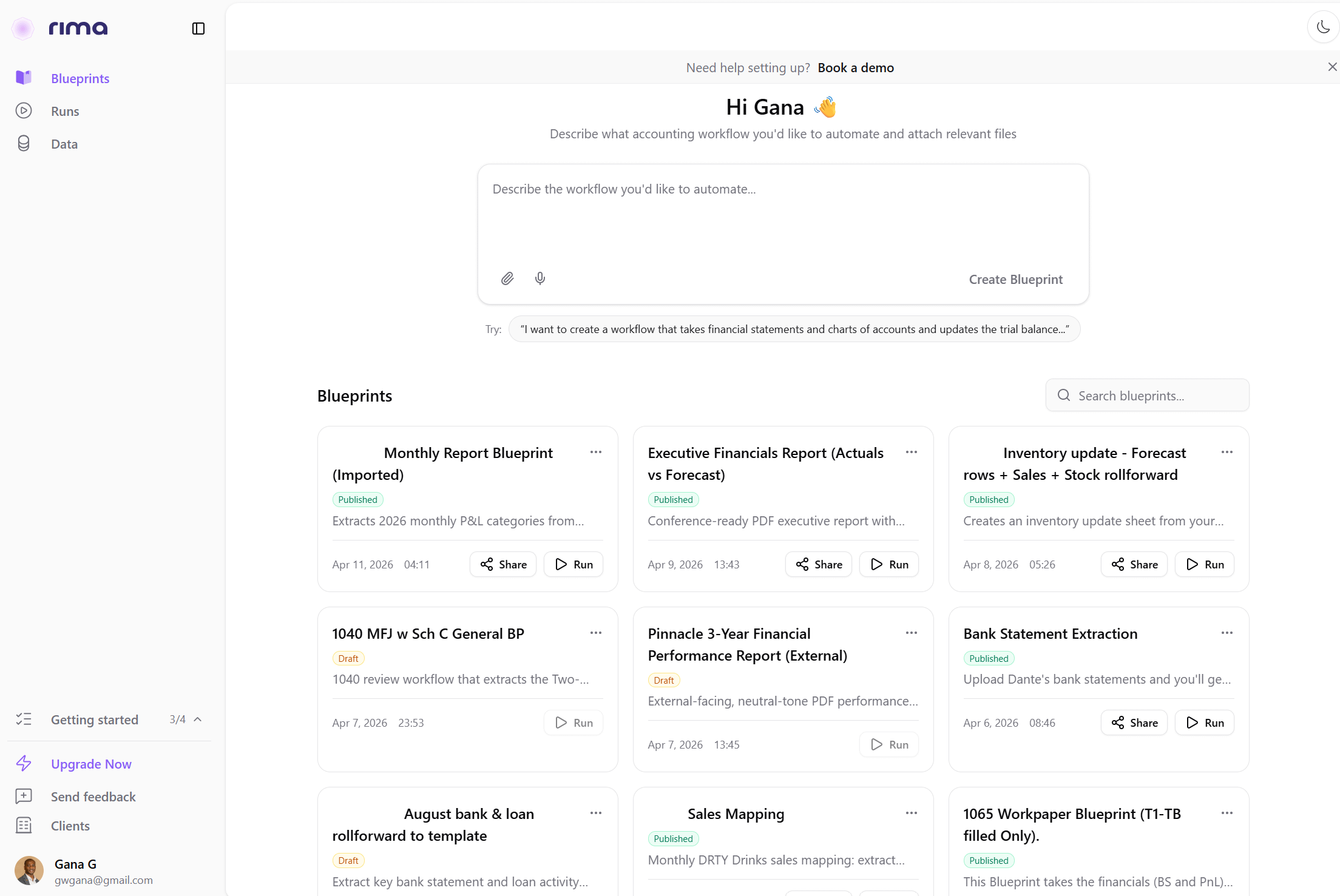
At Rima, we see this play out in the trenches every day. We aren’t building a magic button. We are building the first agent builder for accountants. We turn your natural conversation and your messy templates into deterministic blueprints.
The Blueprint Revolution: Three Stories from the Front Lines
1. The 300-Client Scale-Up
We worked with a firm that was spending hours per client prepping 1120 and 1065 tax workpapers. Pulling statements and matching charts of accounts is the definition of boring work. They showed Rima their template and explained the logic via chat. Rima built the code to handle the data extraction. Now, they don’t do one client at a time. They run that blueprint for all clients simultaneously. It takes minutes instead of weeks.
2. The Law Firm Logic
Law firms are notorious for sending data in formats that change every single month. Rows move and columns disappear. It makes traditional automation impossible. With Rima, the accountant simply defined what they cared about. Rima codified those rules into a blueprint. Now, the input can be as messy as it wants. The code knows what to look for. The job is done the moment the files are uploaded.
3. The Multi-Store Ghost Hunter
We recently mapped out a workflow for a business owner with six credit cards across multiple stores. Their accountant is underwater because bank reconciliation simply takes too long. Every month is a manual slog of matching rules in Excel. We showed them how a simple conversation with Rima creates a blueprint that codifies their knowledge into an application. It turns their specific rules into code that handles the fallbacks and edge cases. Instead of a manual hunt for discrepancies, they get a final report in seconds.
The End of the Bloated ERP
We are entering a world where software is being commoditized.
Why pay for a bloated ERP with a fancy UI and a thousand features you don’t use? Those point solutions are about to be eaten by agentic coders who can write custom software to solve your specific workflow in seconds.
Today, your office is filled with folders of spreadsheets that you share with team members to get work done.
In the future, those folders will be filled with Blueprints.
These are agentic applications that you “write” through conversation. They are shared just like a spreadsheet, but they do the work fully autonomously. They offer the mathematical certainty of code without the need for a computer science degree.
We are building this future today at Rima AI. The goal isn’t to make you a programmer. The goal is to give you the leverage of one so you can finally get back to the work that actually matters.
And maybe you can finally get home in time for dinner.